



The best commercial coffee machine is the one that matches how many cups you serve, who makes them and what you can plumb in. That is the honest answer. It is also why, when someone calls about the commercial coffee machines we supply, David asks about the space, the volume and the budget before he recommends anything.
A two-group espresso machine is wasted in a ten-person office. A pour-in filter brewer will not keep a cafe queue moving at 8am. This guide covers the main types of commercial coffee machine sold in the UK, how to size one, what to check before you buy and what it costs to run. It also says plainly what we sell and what we do not.
The three main types of commercial coffee machine
Traditional espresso machines
This is the machine behind the counter in most cafes. The barista grinds the coffee into a handle (the portafilter), locks it into the group head, pulls the shot and steams the milk by hand. Each group head makes one or two espressos at a time, so a two-group machine can make four at once.
A commercial espresso machine suits cafes, coffee shops, restaurants and hotel bars, where someone trained makes the drinks and most of what you sell is espresso, flat whites and cappuccinos. It needs a skilled person on it and a separate grinder next to it. In return you get control over every drink and a machine that keeps up with a queue. We supply Conti espresso machines.
Bulk filter brewers
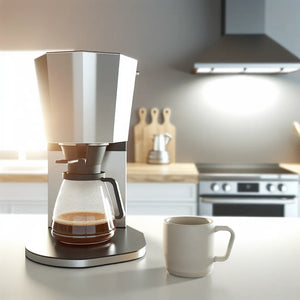
A bulk brewer makes filter coffee in quantity, into a glass jug on a hot plate or a flask that keeps it hot. Pour-in models are filled by hand. Others are plumbed into the mains.
A commercial filter coffee machine suits offices, hotel breakfast service, bed and breakfasts, meeting rooms, care homes and events. Anywhere people want a cup quickly and nobody has time to stand at an espresso machine. Anyone can use one after a minute of training. We supply the Bravilor range.
Bean-to-cup machines
A bean-to-cup machine grinds, brews and, on most models, froths milk at the press of a button. They are common in offices and self-service spots where nobody is trained to make coffee.
We do not sell bean-to-cup machines, so we are not the right people to compare them. If one suits you, you can still buy your beans from us.
One, two or three groups?
Espresso machines are sized by the number of group heads. More groups means more drinks at once, but also a bigger machine, a bigger boiler to keep hot and usually a bigger electrical supply. As a rough guide, one equipment dealer, Bean and Brew Technologies, puts it like this:
- One group: under 80 drinks a day, and roughly 25 to 35 drinks an hour at most.
- Two groups: 80 to 300 drinks a day. Around 60 to 80 drinks an hour with one barista, and 100 to 120 with two.
- Three groups: 300 drinks a day and up.
Treat those numbers as a starting point, not a rule. Your busiest hour matters more than your daily total. A cafe doing 150 drinks a day, with 60 of them between 8 and 9am, needs more than one group.
Both Conti machines we list are two-group models. Conti also make the CC100 in one-group, compact two-group and three-group versions, and the NG-C as a three-group. Ask us if you need one of those.
Filter brewers are sized in litres per hour. The pour-in Bravilor brewers we list make up to about 18 litres an hour, roughly 144 cups.
What to check before you buy
Electrical supply
Most single-group machines, and some two-group machines, run from a standard 13 amp socket. Many two-group machines and most three-group machines need a dedicated, higher-rated supply put in by an electrician. Get the spec sheet for the exact machine and show it to your electrician before you order, not after it arrives.
Plumbing and drainage
Most traditional espresso machines need a mains water feed with an isolating valve close by, and a drain for the waste water. You can run the drain hose into a bucket, but nobody enjoys emptying it in the middle of service. A plumbed filter brewer such as the Bravilor Tha needs a mains connection too. Pour-in brewers such as the Bravilor Novo, Iso and Mondo 2 need no plumbing at all, so they can go in an office kitchen, a function room or an event.
Water hardness and filtration
Hard water leaves limescale in boilers, pipes and valves. It hurts the taste and it damages the machine. A water filter on the mains feed takes out the bulk of the limescale and chlorine before the water reaches your equipment.
We supply the Brita Purity 450 (£350) and Purity 600 (£490) systems, which sit on the mains supply between the wall and the machine. How often the cartridge needs changing depends on how hard your water is and how much you use. Your water company can tell you how hard your water is.
Counter space
Measure the counter, then measure it again with the grinder, knock box, milk jugs and cups in place. A two-group machine and a grinder take up more room than most people expect, and the barista needs space to work. If space is tight, the CC100 range includes a compact version.
The grinder you pair it with
An espresso machine is only as good as the grinder next to it. You need one that grinds fine, grinds consistently and keeps up with your busiest hour, so budget for it at the same time as the machine.
Running costs and servicing
Plan for these on top of the price of the machine.
- Cleaning. For a busy cafe, backflush the groups daily and do a full chemical clean weekly. Puly Caff cleaning tablets are £13 to £14 a tub and Puly Milk cleaner is £15, from our coffee machine cleaning products.
- Descaling. Filter brewers need it too. The Bravilor Mondo 2 and Tha both have a prompt that tells you when.
- Servicing. Seals, gaskets and shower screens wear with use. A regular service catches that before it turns into a breakdown on a Saturday morning.
- Electricity. A bigger boiler costs more to keep hot. The Conti CC100 has an Eco Mode, listed as saving up to 40% on power overnight or when you are closed.
We service and repair most commercial espresso machines and grinders, and we book visits around your opening hours. We also run barista training at your site, on your own equipment, and online. See our services page for details.
The machines we supply, and who they suit
Conti espresso machines are the workhorses we put in most of our cafe installations. They are built for busy service, they are easy to maintain and we can get parts quickly when something needs sorting.
For cafes and coffee shops
- Conti CC100 two-group. The everyday cafe machine, with PID temperature control, pre-infusion, auto cleaning and a display that shows boiler temperatures and service reminders.
- Conti NG-C two-group. The centrepiece of the Conti range, designed to look good from the customer side of the counter. It has a full-colour display, a real-time shot timer, volumetric dosing, guided cleaning cycles and service scheduling.
We price the Conti machines on request, because the right setup depends on your counter, your water and your volume. Ask us for a quote.
For offices, hotels and breakfast service
- Bravilor Novo, £460. Pour-in, two glass jugs on two hot plates, up to 18 litres an hour. Suits small to medium offices, catering trolleys and the back of a bed and breakfast kitchen.
- Bravilor Iso, £550. Pour-in. It brews straight into its own 2 litre vacuum flask, so there is no hot plate and nobody has to watch it. The one to pick for a busy breakfast.
- Bravilor Mondo 2, £700. Pour-in, two jugs and two hot plates, around 18 litres an hour, with a coffee-ready signal and a descale prompt. Suits offices, bed and breakfasts and small hotels.
- Bravilor Tha, £875. Plumbed in, so nobody fills it by hand. It brews into an airpot at about 15 to 20 litres an hour, for offices and hotel breakfast service. The airpot and filter papers are sold separately.
Grinders
- Compak i6 Pro, £1,230. A professional grinder with 64mm hardened steel burrs, for low to mid volume cafes.
- Cunill automatic grinders, £400 to £474. The Cunill 1 kilo has a stainless steel body, a 1kg hopper and an automatic doser, and suits small cafes.
- Eureka Mignon Specialita, £395. Compact, with 55mm flat burrs, and it grinds on demand. Suits smaller venues, or a second grinder for decaf.
Equipment stock changes, so check with us before you plan around one model, or see all our grinders. For the coffee itself, business customers can open a trade account for trade pricing, with 1kg bags from £17.50. Start with our espresso coffee beans or filter coffee.
Questions we get asked
What is the best coffee machine for a cafe?
For most cafes selling espresso drinks, a two-group espresso machine with a good grinder. It keeps up at the morning rush and leaves room to grow. Under about 80 drinks a day, one group can be enough.
What is the best office coffee machine?
For most offices, a bulk filter brewer. It is quick, anyone can use it and it costs a fraction of an espresso machine. A pour-in model like the Bravilor Novo needs no plumbing. If the office wants espresso drinks with nobody trained to make them, that is bean-to-cup, which we do not sell. Our coffee for offices page has more.
Do you service machines you did not supply?
Our servicing covers most commercial espresso machines and grinders. Tell us the make and model and we will tell you if we can help.
If you are still not sure which way to go, get in touch. David will ask about your space, your volume and your budget, then tell you honestly what he would recommend.